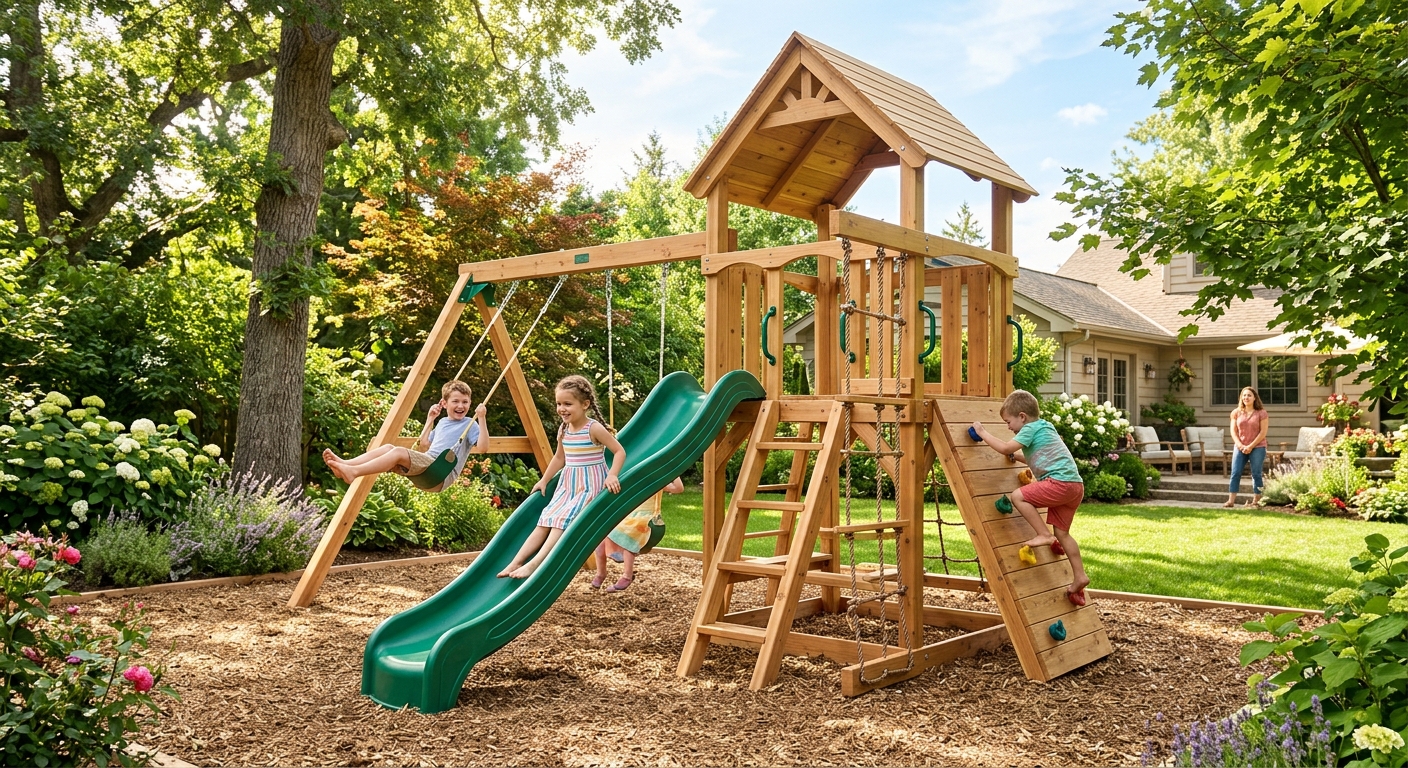
What Are the Safety Standards for Playsets?
Playset safety standards are defined by the Consumer Product Safety Commission (CPSC) and ASTM International’s F1148 specification. The CPSC reports over 200,000 annual playground-related injuries, making compliance critical for home playsets.
Key requirements include:
- Structural integrity: ASTM F1148-21 requires bolts to withstand 500lb static loads
- Entrapment prevention: Openings must be <3.5" or >9" to prevent head entanglement
- Fall protection: Guardrails required on platforms over 30" high (CPSC #325)
- Material safety: No toxic finishes or splinter-prone wood (ASTM F963)
The practical issue is enforcement. While public playgrounds face inspections, home playsets rely on buyer awareness. Our safety guide details how to verify compliance markings (look for "ASTM F1148" stamped on components).
How High Should a Playset Fall Zone Be?
The CPSC mandates a 6ft fall zone for playsets up to 8ft tall, expanding by 1.5x the height for taller structures.
Playset Height vs. Minimum Fall Zone:
| Playset Height | Minimum Clearance | Required Surfacing Depth | |
| --------------- | ------------------ | -------------------------- | |
| 4ft | 6ft | 6" mulch | |
| 6ft | 6ft | 9" mulch | |
| 8ft | 6ft | 12" mulch | |
| 10ft | 15ft | 12" rubber tiles |
Critical detail: Grass fails CPSC impact tests—only engineered wood fiber or rubber tiles meet ASTM F1292 standards for g-max <200. Measure your space before selecting a playset.
What Is the ASTM Standard for Playsets?
ASTM F1148-21 specifies material strength, hardware corrosion resistance, and design safety for home playsets. The standard requires:
- Galvanized steel hardware (minimum 0.15" thickness)
- Load-bearing components tested to 250% of expected weight
- Rounded edges (<0.03" radius) on all accessible metal parts
Most buyers miss this: ASTM compliance stickers fade. Check for rust-proof zinc-plated bolts (magnetic = non-compliant) and smooth welds. Annual maintenance preserves ASTM certification.
How Often Should You Inspect a Playset?
CPSC recommends monthly visual checks and seasonal deep inspections—90% of wear-related hazards are caught this way.
Monthly Checks:
- Loose bolts (tighten to 25 ft-lbs torque)
- Splintered wood (sand if >1/8" deep)
- Frayed ropes (replace if >3 strands broken)
Seasonal Checks:
- Rot (probe wood with screwdriver—soft spots fail)
- Rust (metal components should show no pitting)
- UV damage (vinyl shouldn’t crack when flexed)
Download our checklist with torque specs and replacement intervals.
What Are Common Playset Hazards?
67% of playset injuries involve falls, but CPSC data shows these hidden risks:
- Pinch points: Swing hangers need 9" clearance (ASTM F1918)
- Protrusions: Bolt ends must be <0.04" beyond nuts
- Entrapment: Ladder rungs spaced 12-16" apart
- Tip-over: Anchors required for >4ft freestanding units
- Heat hazards: Metal slides exceed 140°F in direct sun
The trade-off is straightforward: Vinyl resists heat but lacks wood’s natural grip. Compare materials for your climate.
Bottom Line: Are Playset Safety Standards Non-Negotiable?
CPSC and ASTM standards reduce injury risks by 48%—non-compliance risks liability and harm.
Key takeaways:
- Fall zones must extend 6ft for 8ft-high playsets with 12" mulch
- Monthly inspections catch 90% of hazards before failure
- ASTM F1148 markings fade—verify galvanized hardware annually
Shop compliant playsets with lifetime hardware warranties.